


Intro. Machine Learning
This module introduces the core concepts of Machine Learning and its importance in today’s data-driven world. Students learn how machines use data to identify patterns, make predictions, and improve performance without explicit programming. The course covers key learning types supervised, unsupervised, and reinforcement learning along with real-world applications in business, healthcare, and technology. You’ll also explore essential ML tools like Python, Scikit-learn, and TensorFlow. By the end, learners gain a solid conceptual foundation and practical understanding of how Machine Learning powers modern innovations like recommendation systems, predictive analytics, and intelligent automation across industries.
Data Pre-Processing
Data Pre-processing focuses on preparing raw, unstructured data for analysis and model training. Students learn to handle missing values, remove duplicates, normalize and scale features, and encode categorical variables. The module emphasizes the importance of clean, consistent, and accurate data in ensuring better model performance. You’ll work hands-on with Python libraries such as Pandas, NumPy, and Scikit-learn to automate data cleaning and transformation tasks. Additionally, Exploratory Data Analysis (EDA) techniques are introduced to identify trends, correlations, and anomalies. By mastering preprocessing, students ensure that their machine learning models are reliable, efficient, and capable.
Supervised Learning
In this module, students explore how machines learn from labeled data to make accurate predictions. You’ll study key supervised learning algorithms like Linear Regression, Logistic Regression, Decision Trees, Random Forests, and Support Vector Machines (SVM). The course focuses on model training, testing, and validation using Scikit-learn in Python. Learners gain hands-on experience in applications such as price prediction, spam detection, and sentiment analysis. You’ll also learn about performance metrics like accuracy and F1-score, along with methods to prevent overfitting and underfitting. By the end, students can confidently build, evaluate, and optimize predictive models for real-world business and data science problems.

Unsupervised Learning
Unsupervised Learning helps uncover hidden structures within unlabeled data. This module covers clustering techniques like K-Means, Hierarchical Clustering, and DBSCAN, as well as dimensionality reduction methods like PCA (Principal Component Analysis). Students learn how to group similar data points, identify patterns, and visualize results for deeper insights. You’ll apply these methods in areas like customer segmentation, fraud detection, and recommendation systems. Through hands-on practice using Python and visualization tools, learners develop strong analytical and problem-solving skills. By mastering unsupervised learning, students gain the ability to analyze complex datasets and discover meaningful relationships without predefined outputs or supervision.

Neural Networks & Deep Learning
This module explores how Neural Networks mimic the human brain to process complex data and drive Artificial Intelligence applications. Students learn about perceptrons, activation functions, backpropagation, and deep architectures such as Convolutional Neural Networks (CNNs). Using TensorFlow and Keras, you’ll build and train deep learning models for image, text, and voice recognition tasks. The course also covers concepts like regularization, dropout, and hyperparameter tuning to optimize performance. Practical exercises focus on real-world AI projects, including object classification and sentiment analysis. By the end, students will be capable of designing and deploying robust neural network models for advanced and detailed analysis.
Natural Language Processing
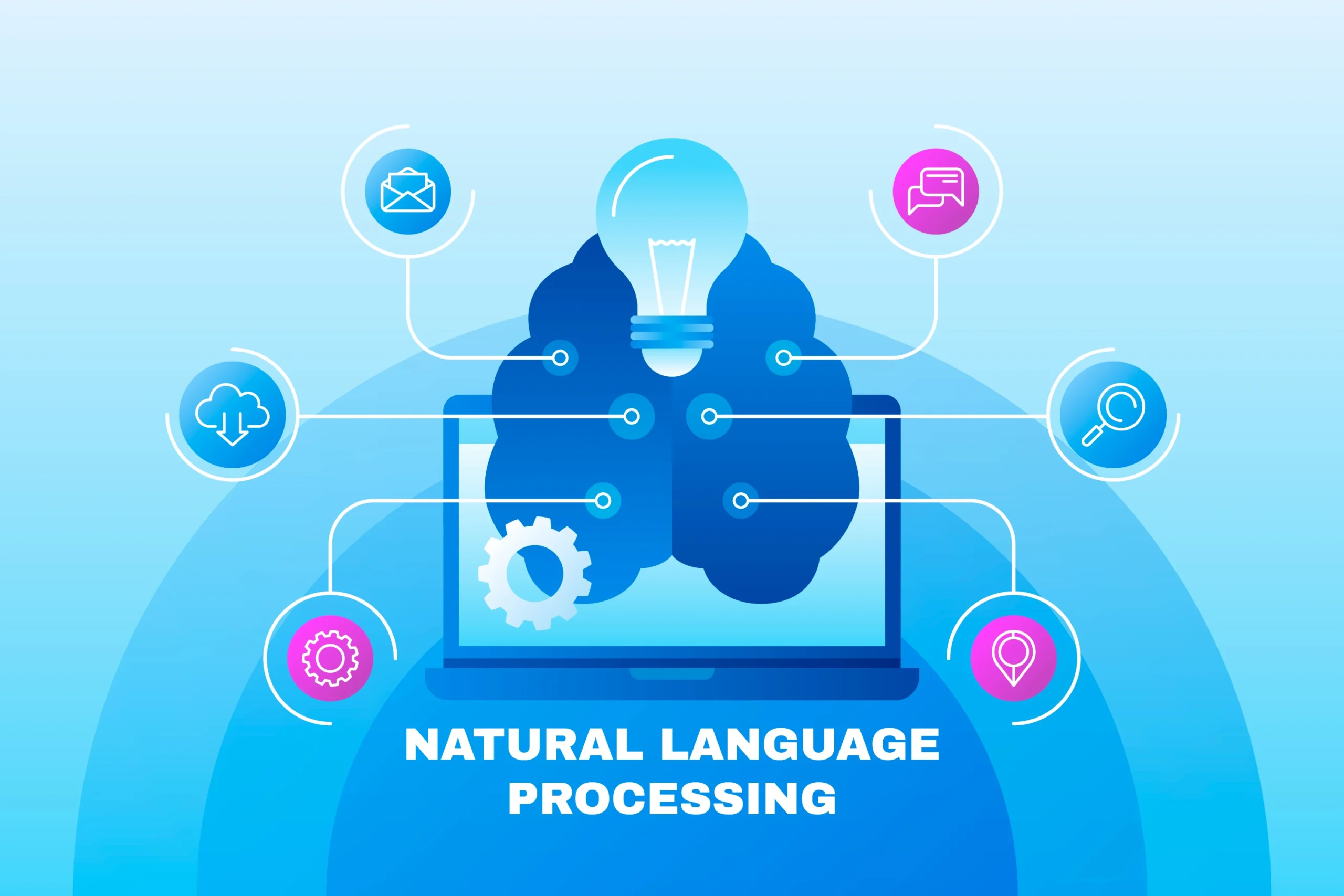
Natural Language Processing (NLP) enables machines to understand, analyze, and generate human language. This module introduces text preprocessing techniques such as tokenization, stemming, lemmatization, and stop-word removal. Students explore applications like sentiment analysis, text classification, and chatbot development using Python libraries like NLTK and Spacy. Advanced concepts such as word embeddings and transformer models (BERT) are also introduced. Through hands-on exercises, learners will build intelligent text-based applications capable of understanding real-world communication. By the end, students gain a strong understanding of how NLP works on technologies like Google Assistant, Siri, and translation tools through integration.
Machine Learning
This module bridges theory and practice by showing how Machine Learning is applied across industries. Students work on case studies in domains like healthcare (disease prediction), finance (fraud detection), e-commerce (recommendation systems), and marketing (customer segmentation). You’ll learn to collect data, train models, and evaluate results in realistic scenarios. The module emphasizes business-oriented problem-solving and model interpretability. Learners also explore ethical considerations, bias reduction, and explainable AI principles. By completing this module, students gain practical exposure to the end-to-end ML workflow, preparing them for real-world applications, data-driven decision-making.

Model Evaluation and Tuning
Model Evaluation and Tuning ensures your ML models perform accurately and reliably. Students learn to use metrics like accuracy, precision, recall, F1-score, and ROC-AUC for performance assessment. The course introduces cross-validation, confusion matrices, and hyperparameter optimization techniques like grid search and random search. You’ll also explore strategies for addressing overfitting, underfitting, and bias-variance tradeoffs. Through hands-on Python practice, learners evaluate and refine classification and regression models for better performance. This module builds strong analytical skills, ensuring students can optimize models for accuracy, generalization.
Machine Learning Deployment
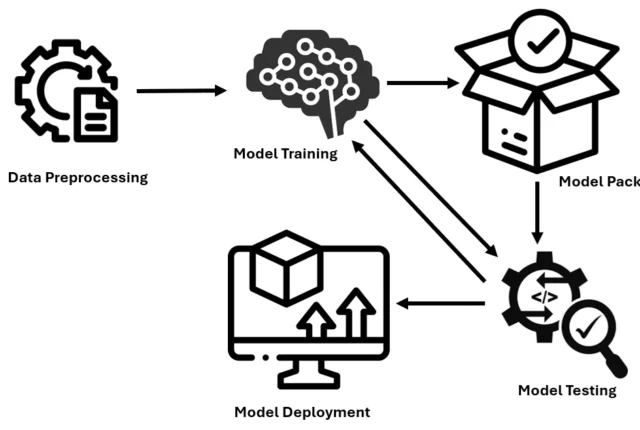
This module teaches how to deploy and integrate machine learning models into real-world applications. Students learn model packaging, API creation using Flask or FastAPI, and deployment on cloud platforms like AWS, Google Cloud, or Azure. You’ll understand version control, model monitoring, and maintaining live systems through continuous updates. The course also covers containerization using Docker for scalability and reliability. By the end, learners will be able to take trained models from experimentation to production-ready environments, ensuring seamless performance, automation, efficiency and usability an essential skill for modern machine learning engineers and data professionals.