

Choosing the right career path after school is one of the most important decisions for students. Many students in Dehradun and across Uttarakhand often get confused between traditional degree programs and job-oriented courses. While both options have their own importance, the modern job market is increasingly demanding practical skills and industry-ready knowledge.
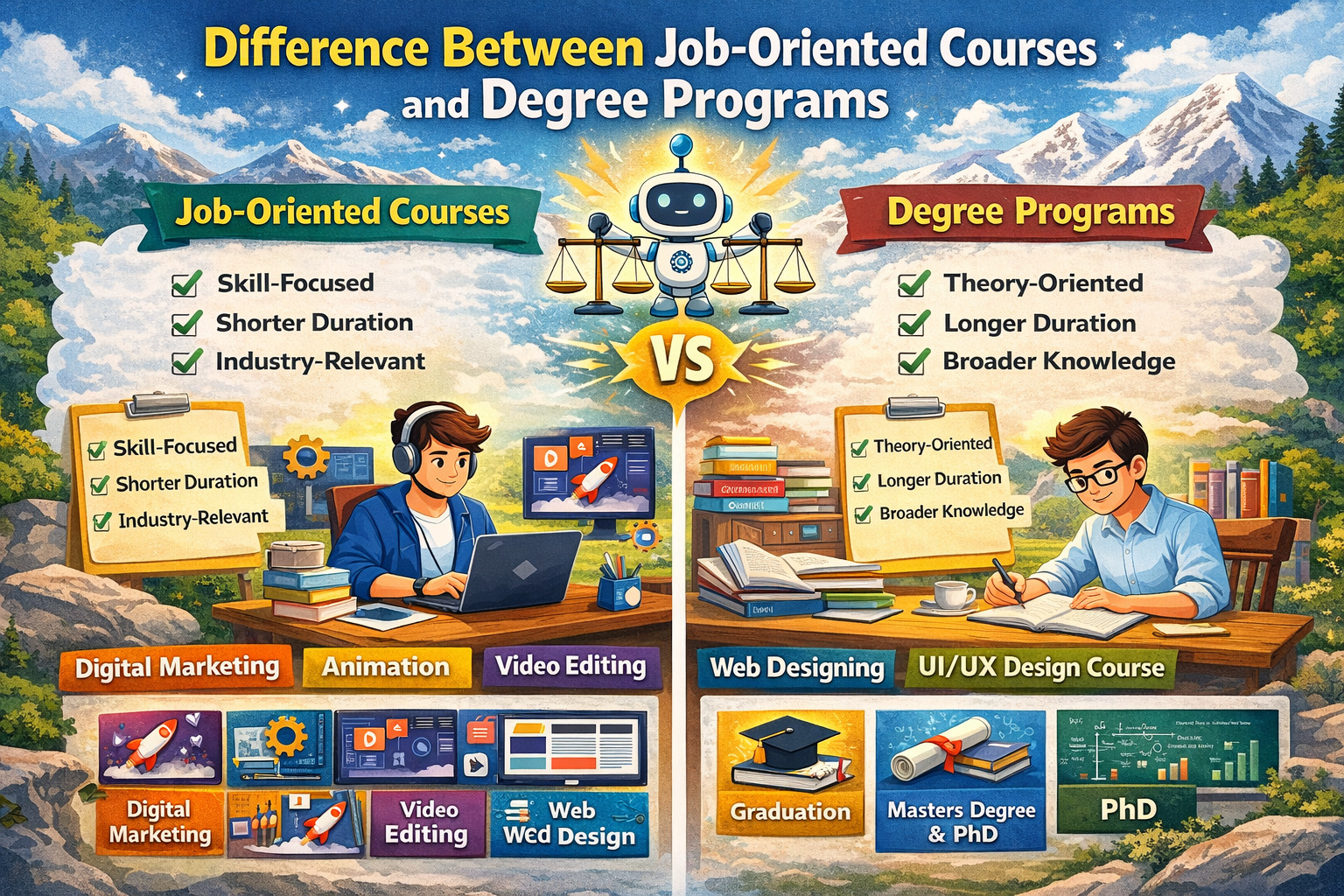
Degree programs usually focus on theoretical understanding over a longer period, while job-oriented courses are designed to provide practical training and specific skills required for a particular job role. With the rapid growth of digital industries, skill-based courses are becoming more popular among students.
What Are Degree Programs?
Degree programs are traditional academic courses offered by colleges and universities. These programs usually take 3–4 years to complete and focus on theoretical knowledge in subjects like Arts, Commerce, or Science.
While degree programs provide a strong educational foundation, they may not always include practical training or industry exposure. As a result, students often need additional skill-based courses to become job-ready.
What Are Job-Oriented Courses?
Job-oriented courses are short-term, skill-based programs that focus on practical learning and real-world applications. These courses are designed to prepare students for specific careers in industries like digital marketing, IT, media, and design.
They include hands-on training, live projects, and industry tools, making students ready for jobs, freelancing, or even starting their own business.
Key Differences Between Job-Oriented Courses and Degree Programs
1. Duration
Degree programs take several years, while job-oriented courses can be completed in a few months.
2. Learning Approach
Degrees focus more on theory, whereas job-oriented courses focus on practical skills and real-world applications.
3. Job Readiness
Job-oriented courses make students job-ready quickly, while degree programs may require additional training.
4. Career Opportunities
Skill-based courses open doors to freelancing, startups, and digital careers, while degrees are often required for traditional jobs.
Top 10 Job-Oriented Courses for Students
1. Digital Marketing
Digital marketing Learn SEO, social media marketing, Google Ads, and online branding to promote businesses.
2. Python
Python A versatile programming language used in web development, automation, AI, and data science.
3. Animation
Animation Create 2D and 3D animations for films, gaming, and advertising.
4. Video Editing
Video editing Develop skills to create professional videos, reels, and promotional content.
5. Web Designing
Web Designing and develop responsive websites for businesses and personal brands.
6. UI/UX Design Course
UI/UX Design Focus on improving user experience and interface design for websites and apps.
7. Machine Learning
Machine Learning Learn AI-based technologies used in automation, prediction, and data analysis.
8. Graphic Designing
Graphic Designing Create logos, branding materials, and social media graphics.
9. Data Analyst
Data Analyst and interpret data to help businesses make better decisions.
10. Premiere Pro
Master Adobe Premiere Pro to create professional-level video content.
Why Choose These Courses?
These courses are designed to provide practical knowledge and real industry skills.
-
High demand in today’s job market
-
Short duration with quick career start
-
Hands-on training and real projects
-
Freelancing and remote work opportunities
-
High salary potential in digital fields
Students can build careers in IT companies, digital marketing agencies, media houses, startups, or work independently as freelancers.
Conclusion
Both degree programs and job-oriented courses have their own importance, but the modern job market is shifting towards skill-based learning. While degrees provide theoretical knowledge, job-oriented courses focus on practical skills that help students become job-ready. In today’s digital world, courses like Digital Marketing, Python, Animation, Video Editing, Web Designing, UI/UX Design, Machine Learning, Graphic Designing, Data Analysis, and Premiere Pro are highly valuable. By combining the right education with practical skills, students in Dehradun and Uttarakhand can build successful and future-ready careers.
FAQs
1. Which is better: degree or job-oriented courses?
Both are important, but job-oriented courses help you gain practical skills faster.
2. Can I do job-oriented courses after 12th?
Yes, these courses are suitable for students from all streams.
3. Do job-oriented courses guarantee jobs?
They improve your chances by making you job-ready with practical skills.
4. Are these courses useful for freelancing?
Yes, skills like digital marketing, graphic design, and video editing are in high demand for freelancing.
5. Can I do both degree and job-oriented courses together?
Yes, many students pursue skill-based courses along with their degree for better career opportunities.