

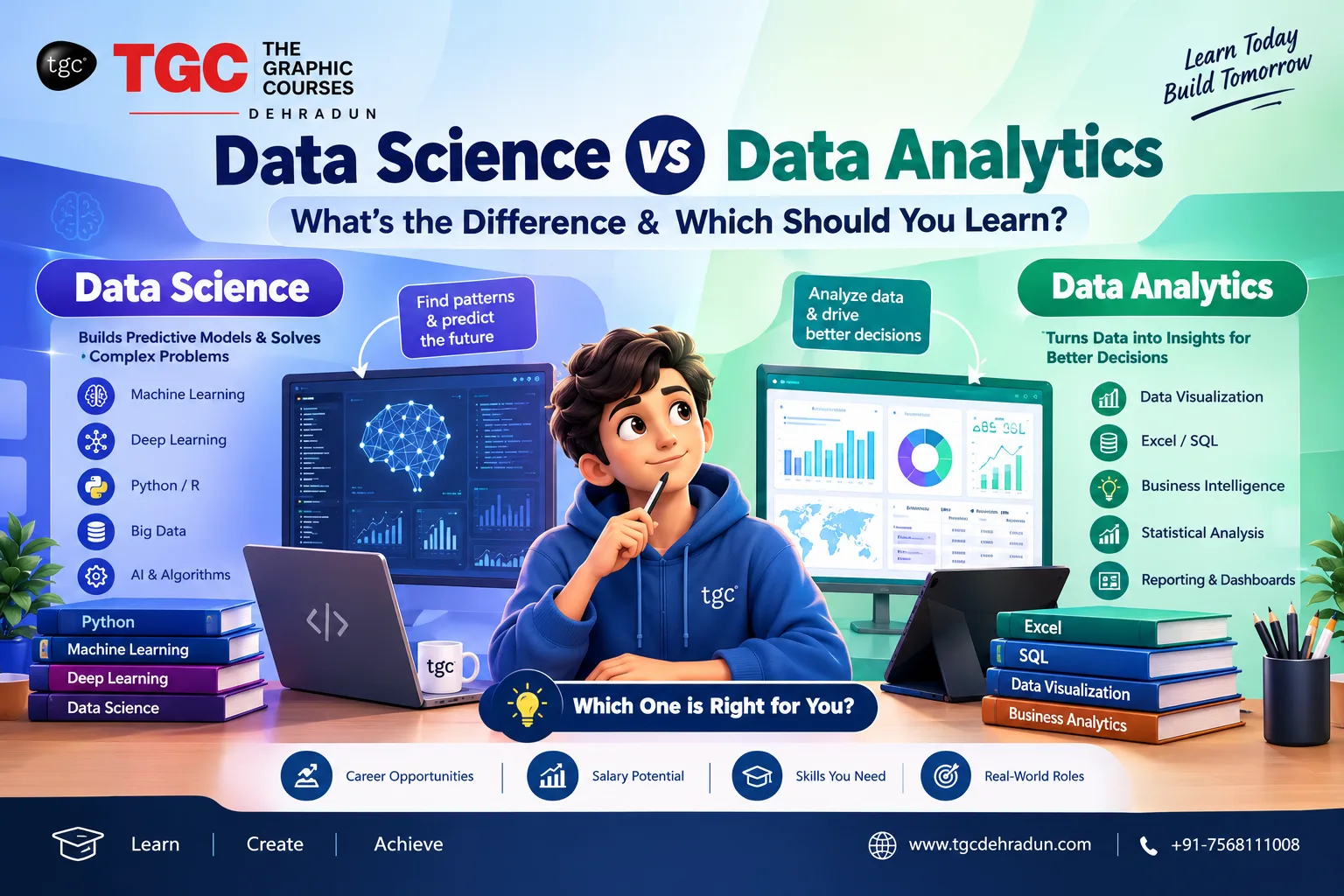
If you’ve been researching a career in the data field, you’ve probably noticed that “data science” and “data analytics” get used almost interchangeably — in job postings, course names, and casual conversation. But they’re not the same thing, and choosing the wrong path based on a vague understanding of the difference can cost you months of misdirected learning.
Both fields deal with data. Both are in high demand. But they require different skill sets, suit different types of thinkers, and lead to different career trajectories. This guide breaks down exactly how data science and data analytics differ, and helps you figure out which one actually fits your goals.
What Is Data Analytics?
Data analytics is the process of examining existing data to identify trends, patterns, and insights that help answer specific business questions. Analysts work primarily with structured data — data that’s already been collected and organized — to explain what happened and why it happened.
Think of a data analyst as someone who looks at a company’s sales data and explains: “Sales dropped 15% in Q3 because of reduced repeat purchases in the North region.”
Core Focus of Data Analytics
- Interpreting historical and current data
- Building dashboards and reports for business decision-making
- Identifying trends, anomalies, and patterns
- Communicating findings clearly to non-technical stakeholders
Common Data Analytics Tools
| Category | Tools |
| Spreadsheet & BI Tools | Excel, Power BI, Tableau |
| Query Language | SQL |
| Programming (basic) | Python (Pandas, NumPy) |
| Visualization | Matplotlib, Power BI dashboards |
What Is Data Science?
Data science is a broader, more technical discipline that goes beyond explaining past data — it focuses on building predictive models and systems that forecast future outcomes or automate decision-making. Data scientists work with both structured and unstructured data, and their toolkit includes statistics, machine learning, and programming at a much deeper level.
Think of a data scientist as someone who doesn’t just explain why sales dropped — they build a model that predicts which customers are likely to churn next quarter, so the business can act before it happens.
Core Focus of Data Science
- Building machine learning models for prediction and classification
- Working with large, often unstructured datasets (text, images, sensor data)
- Designing algorithms and automated data pipelines
- Applying advanced statistics and probability to solve complex problems
Common Data Science Tools
| Category | Tools |
| Programming | Python, R |
| Machine Learning | Scikit-learn, TensorFlow, PyTorch |
| Data Handling | Pandas, NumPy |
| Databases | SQL, sometimes NoSQL (MongoDB) |
| Deployment | Basic cloud/ML deployment tools |
Data Science vs Data Analytics: Side-by-Side Comparison
| Factor | Data Analytics | Data Science |
| Primary Goal | Explain what happened and why | Predict what will happen next |
| Data Type | Mostly structured | Structured and unstructured |
| Core Skills | SQL, Excel, Power BI, basic Python | Python/R, statistics, machine learning |
| Math/Stats Depth | Moderate | Advanced (statistics, probability, linear algebra) |
| Typical Output | Reports, dashboards, insights | Predictive models, algorithms, automated systems |
| Learning Curve | Shorter, more beginner-friendly | Longer, more technically demanding |
| Common Job Titles | Data Analyst, Business Analyst | Data Scientist, ML Engineer |
Career Paths and Roles
Data Analytics Career Path
- Data Analyst — the most common entry point, working across nearly every industry (retail, finance, healthcare, marketing)
- Business Analyst — focuses specifically on translating data insights into business strategy.
- Reporting/BI Analyst — specializes in building dashboards and automated reporting systems.
Data Science Career Path
- Data Scientist — builds predictive models and works closely with engineering and product teams.
- Machine Learning Engineer — focuses on deploying and scaling ML models into production systems.
- AI/Research Engineer — works on more experimental, cutting-edge model development.
Salary Expectations: Data Analytics vs Data Science
Salaries in both fields have grown steadily as businesses increasingly rely on data-driven decision-making. In general:
- Data Analysts typically earn solid entry-level salaries, with strong growth as they take on business analyst or senior analyst responsibilities.
- Data Scientists generally command higher salaries than analysts at equivalent experience levels, due to the deeper technical skill set (statistics, ML, programming) required.
- Both fields see significant salary growth with specialization — analysts who master BI tools deeply, and data scientists who specialize in machine learning or NLP, tend to out-earn generalists in their respective fields.
The gap between the two roles has narrowed somewhat as companies increasingly value analysts who can also code and build basic predictive models — which is exactly why many training programs now blend both skill sets.
Which One Should You Learn? A Simple Decision Framework
Choosing between data analytics and data science doesn’t have to be complicated. Ask yourself these questions:
Choose Data Analytics if:
- You prefer working with clear, structured business questions.
- You enjoy communicating insights through visuals and dashboards.
- You want a faster path into the job market with a shorter learning curve.
- You’re more comfortable with tools like Excel, SQL, and Power BI than heavy coding.
- You want to work closely with business teams and decision-makers
Choose Data Science if:
- You enjoy deep problem-solving, statistics, and mathematical thinking.
- You’re comfortable (or willing to become comfortable) with programming in Python or R.
- You’re interested in building predictive models, AI systems, or automation.
- You’re willing to invest more time upfront for a more technical, often higher-ceiling career.
- You want to eventually move toward machine learning, AI, or research-focused roles.
A Practical Middle Path
Many professionals today don’t choose one exclusively — they start with data analytics fundamentals (SQL, Excel, Python basics, visualization) and progressively build toward data science skills (statistics, machine learning) as they grow more confident. This layered approach is often the most sustainable way to enter the field, especially for beginners or career-switchers coming from non-technical backgrounds.
Why Foundational Skills Matter Regardless of Path
Whichever path you choose, certain foundational skills remain non-negotiable:
- Python — the backbone of both modern data analytics and data science workflows
- SQL — essential for extracting and managing data regardless of your specialization
- Statistics fundamentals — even analysts benefit from understanding basic statistical concepts.
- Data visualization — the ability to communicate findings clearly is valuable in both fields
This is exactly why well-structured training programs increasingly combine both disciplines rather than teaching them in isolation — giving students the flexibility to specialize once they discover which direction genuinely excites them.
Where to Learn Data Science & Analytics in Dehradun
TGC Dehradun’s Data Science Course is designed to cover this exact progression — starting with Python fundamentals, data wrangling, and SQL, then advancing into machine learning, AI, and data visualization with tools like Power BI. The course includes hands-on projects with real-world datasets, helping students build a portfolio that demonstrates both analytical and predictive modeling capabilities.
For those specifically drawn to the analytics side of the field, the dedicated Data Analyst Course in Dehradun focuses on business intelligence, dashboard design, SQL, Excel, and Python-based analytics — ideal for students who want a faster, business-focused entry into the data field.
Students building a broader technical foundation first can also explore a Python programming course, which covers the libraries — NumPy, Pandas, Matplotlib — that underpin both data analytics and data science work, making it a strong starting point regardless of which specialization you eventually choose.
Final Thoughts
Data analytics and data science aren’t competing careers — they’re two related disciplines with different depths, tools, and outcomes. Analytics is about understanding and explaining data to support better decisions today; data science is about building systems that predict and shape decisions for tomorrow.
There’s no universally “better” choice — only the one that matches your interests, mathematical comfort level, and career goals. Whichever path you choose, the most important step is building strong foundational skills in Python, SQL, and data thinking — skills that keep both doors open as your career evolves.
Ready to start your data career? Explore TGC Dehradun’s Data Science and Data Analytics courses and get hands-on, project-based training designed to get you job-ready.