

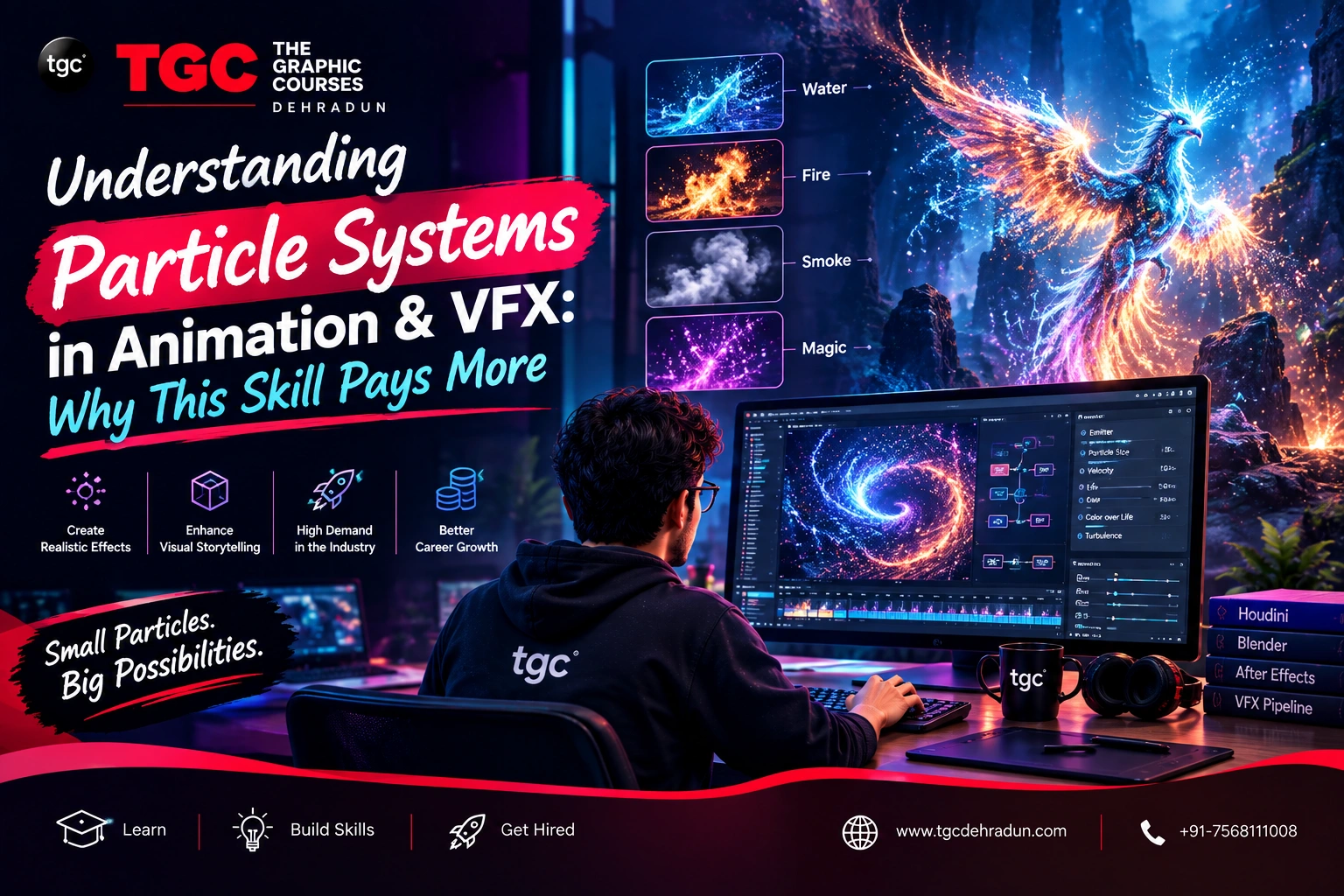
Every time you watch fire roar across a screen, snow drift realistically past a window, or a building crumble into a cloud of dust and debris, you’re watching a particle system at work. It’s one of the most visually spectacular and technically demanding skills in the entire VFX pipeline, which is exactly why artists who master it consistently earn more than generalist animators and compositors.
This guide breaks down what particle systems actually are, how they work, the tools professionals use, and why this specific skill has become one of the strongest salary differentiators in animation and VFX today.
What Is a Particle System?
A particle system is a technique used to simulate complex, often chaotic visual phenomena like fire, smoke, water, dust, sparks, or magical effects by generating and controlling large numbers of small individual elements called particles, rather than animating each element by hand.
Instead of manually keyframing thousands of individual flame licks or dust motes, an artist defines a set of rules how particles are born, how they move, how they interact with forces like gravity and wind, and how they die and lets the simulation generate the motion automatically.
This is a defining example of procedural animation: rule-based, physics-driven motion that would be virtually impossible to create by hand at the same scale of realism.
The Core Building Blocks of a Particle System
Understanding particle systems starts with a handful of core concepts that appear across virtually every software platform:
| Component | What It Does |
|---|---|
| Emitter | Defines where and how particles are “born” — a point, surface, or volume |
| Particle Attributes | Individual properties like size, color, lifespan, and velocity assigned to each particle |
| Forces | Physical influences like gravity, wind, turbulence, and drag that affect particle motion |
| Collisions | Rules governing how particles interact with objects or surfaces in the scene |
| Life Cycle | How long a particle exists — its birth, aging, and death (fade-out, dissipation) |
| Renderer | How particles are visually displayed — as points, sprites, meshes, or volumetric shapes |
Mastering these fundamentals is what allows an artist to move from “making something that technically looks like fire” to “making fire that feels physically believable and emotionally right for the scene.”
Common Real-World Uses of Particle Systems
Particle systems aren’t a niche technique they’re used constantly across film, television, gaming, and advertising:
- Fire, smoke, and explosions — one of the most common and highest-demand applications in the VFX industry
- Weather effects — rain, snow, fog, and dust storms
- Destruction and debris — buildings collapsing, glass shattering, walls crumbling
- Magical and fantasy effects — glowing energy, sparkles, portals, and spell effects common in fantasy films and games
- Crowd and swarm simulation — flocks of birds, swarms of insects, or large crowds of background characters
- Liquid and fluid simulation — splashing water, flowing lava, or viscous liquids (technically a specialized branch built on similar underlying principles)
- Motion graphics — abstract particle trails and dynamic effects widely used in title sequences, ads, and branding videos
Why Particle Systems Are a Higher-Paying Specialization
This is the part most aspiring animators don’t realize early enough: not all VFX skills pay the same, and particle/FX simulation work sits near the top of the pay scale.
| VFX Specialization | Why It Pays What It Pays |
|---|---|
| Roto/Compositing (entry-level) | High demand, but lower technical barrier — more artists can do this work |
| 3D Character Animation | Requires strong artistic and performance skills, moderate technical demand |
| FX / Particle Simulation (Houdini) | Requires deep technical + artistic skill combined — genuinely scarce talent pool |
FX Technical Directors the specialists who build these complex particle and simulation systems, most commonly using Houdini routinely earn significantly more than generalist animators or compositors at similar experience levels. This isn’t a coincidence: building a believable, art-directable fire simulation requires a rare combination of physics understanding, procedural/technical scripting ability, and a genuine artistic eye for timing and composition. Very few artists develop all three deeply, which keeps demand for skilled FX TDs consistently higher than the available talent supply.
International VFX studios the same ones producing effects for major Hollywood films routinely outsource simulation-heavy shots to Indian studios specifically because of this skill scarcity, which has helped push FX/particle specialist salaries well above the industry average in India’s growing VFX sector.
The Tools Professionals Use for Particle Systems
| Software | What It’s Known For |
|---|---|
| Houdini (SideFX) | The undisputed industry standard for procedural particle and FX simulation work |
| Autodesk Maya (nParticles, Bifrost) | Strong particle tools integrated into a broader animation/modeling pipeline |
| Adobe After Effects (Particular plugin, native particle tools) | Popular for motion graphics and simpler 2D/2.5D particle effects |
| Unreal Engine (Niagara) | Real-time particle systems used heavily in games and virtual production |
| Blender (Particle System, Geometry Nodes) | A growing, free/open-source option increasingly used for procedural effects |
Houdini remains the clear industry leader for high-end film and VFX work specifically because of its node-based, fully procedural workflow every step of a simulation is visible, editable, and reusable, which is exactly what large studios need when iterating on complex shots under tight deadlines.
What It Actually Takes to Learn Particle Systems Well
Particle and FX simulation work has a genuinely steeper learning curve than many other animation specializations, which is part of why it’s rewarded so well. Building real competence requires:
- Solid animation fundamentals first — understanding timing, weight, and motion principles, since a technically perfect simulation with poor artistic timing still won’t look right
- Comfort with procedural, node-based thinking — particle work in Houdini especially rewards a logical, systems-based approach rather than purely intuitive, hand-drawn animation instincts
- Basic physics intuition — understanding how real fire, smoke, water, and debris actually behave informs believable simulation setups
- Patience with iteration — simulations often require dozens of adjustment cycles (tweaking forces, collisions, and rendering) before they look right, and the render times involved mean iteration cycles can be genuinely slow
- A strong technical eye for art direction — knowing when a simulation “looks right” for the shot’s mood, not just physically accurate
Career Path: From Generalist to FX Specialist
Most artists don’t start their career in particle simulation directly — it’s typically a specialization built on top of broader animation and VFX fundamentals:
- Learn core 3D fundamentals — modeling, animation principles, and general software literacy (Maya or Blender)
- Build general VFX and compositing skills — understanding how simulations fit into a complete shot, including lighting, rendering, and compositing
- Specialize deliberately in Houdini/FX — once fundamentals are solid, dedicated study of Houdini’s particle and dynamics tools opens the door to FX-specific roles
- Build a focused FX showreel — a portfolio demonstrating fire, smoke, destruction, or fluid simulation work specifically, since generalist reels don’t showcase this specialized skill effectively
This deliberate specialization path is exactly why aspiring artists benefit from structured training that builds strong fundamentals before advancing into more technical simulation work — jumping straight into Houdini without foundational animation and VFX knowledge often leads to technically functional but artistically weak results.
Where to Build These Skills in Dehradun
TGC Dehradun’s Animation Course builds exactly this foundation covering core animation principles, character design, and 2D/3D fundamentals the essential groundwork before advancing into more technical, simulation-focused VFX work.
For students ready to specialize further, the dedicated VFX Course in Dehradun covers compositing, simulation, and dynamics using industry-standard tools, directly building toward the kind of FX specialization that commands premium salaries in the industry. Students seeking a more comprehensive program covering the complete pipeline from animation through compositing can also explore the Diploma in VFX or the Diploma in 2D/3D Animation and Post Production, both designed to prepare students for real production pipelines across film, VFX, and gaming.
Final Thoughts
Particle systems represent one of the most technically demanding and financially rewarding specializations in the entire animation and VFX pipeline. The combination of physics understanding, procedural thinking, and genuine artistic judgment required to build believable fire, smoke, or destruction effects is rare enough that skilled FX artists consistently command premium salaries compared to generalist animators.
For students serious about maximizing their long-term earning potential in this field, the path is clear: build strong animation fundamentals first, then deliberately specialize in procedural, simulation-driven tools like Houdini because in animation and VFX, depth in a scarce, technical skill pays significantly more than breadth alone.
Ready to specialize in high-paying VFX skills like particle simulation? Explore TGC Dehradun’s Animation & VFX courses and get hands-on, industry-relevant training designed to get you hired.