

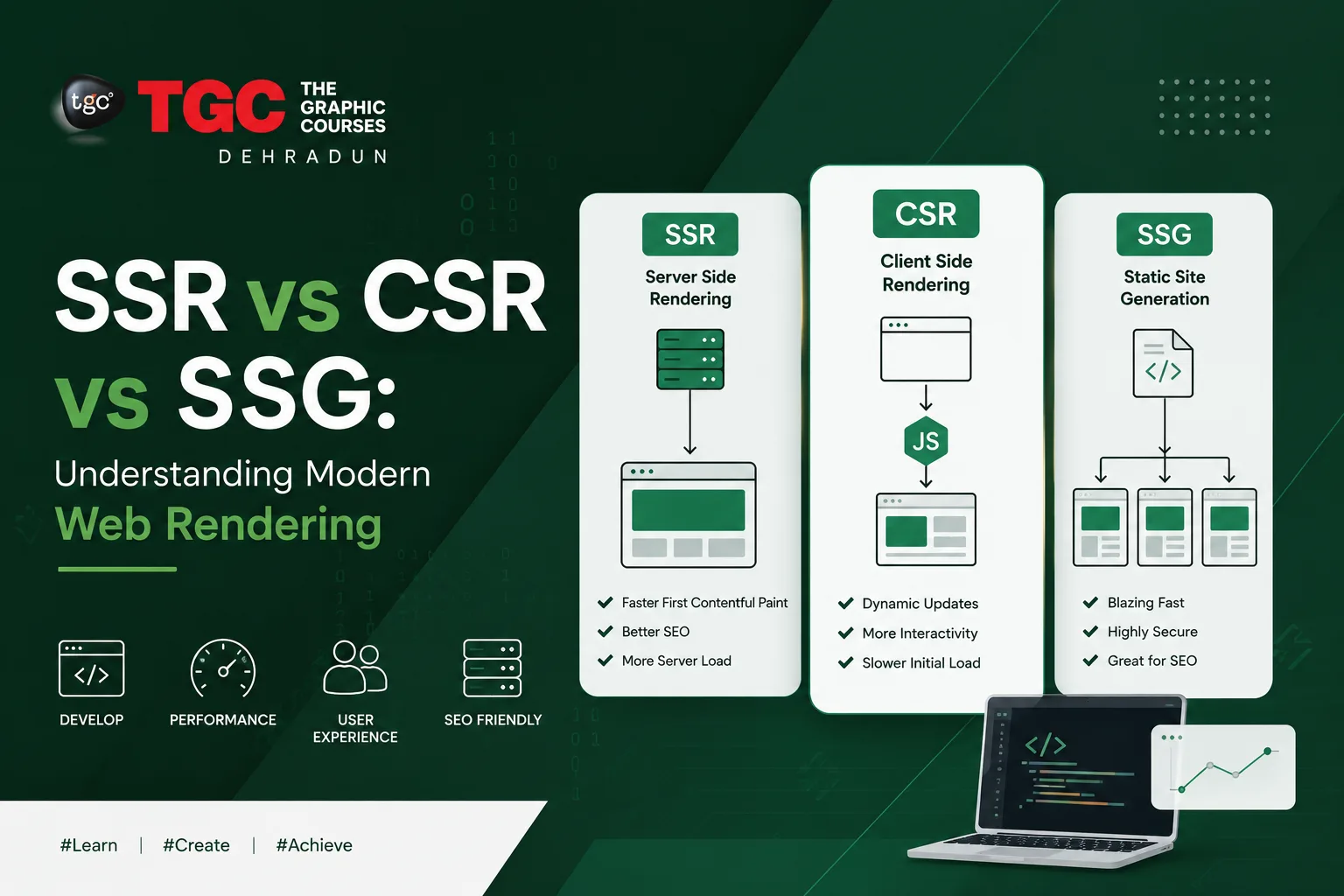
If you’ve spent any time building or learning about modern websites, you’ve probably run into three acronyms that get thrown around constantly: SSR, CSR, and SSG. They sound technical, but at their core, they answer one simple question: where and when does your webpage actually get built?
Understanding rendering methods isn’t just a “backend developer” concern anymore. It affects site speed, SEO rankings, user experience, and even hosting costs. Whether you’re a student learning front-end development or a business owner choosing a tech stack, knowing the difference between these three approaches will help you make smarter decisions.
Let’s break each one down in plain language.
What Does “Rendering” Actually Mean?
Rendering is the process of turning raw code (HTML, CSS, JavaScript, and data) into the visual webpage a user sees in their browser. The big question rendering strategies try to answer is: should the page be built on a server, in the browser, or in advance—before anyone even visits?
That’s the entire difference between SSR, CSR, and SSG.
Client-Side Rendering (CSR)
How It Works
With CSR, the server sends a mostly empty HTML file along with a JavaScript bundle. The browser then downloads that JavaScript, runs it, and builds the actual page in the user’s browser. Frameworks like React, Vue, and Angular popularized this model in their default configurations.
Pros of CSR
- Smooth, app-like interactions once the page loads — no full page reloads between views.
- Great for highly interactive apps like dashboards, admin panels, or tools where SEO isn’t a priority.
- Simpler backend — the server just serves static files and an API; it doesn’t need to render pages.
Cons of CSR
- Slower initial load — users often see a blank screen or loading spinner while JavaScript downloads and executes.
- Weaker SEO out of the box — search engine crawlers historically struggled with JavaScript-heavy pages, though modern crawlers have improved.
- Performance depends heavily on the user’s device — a low-end phone will render CSR pages much slower than a powerful laptop.
Best for: Internal tools, dashboards, SaaS products, and apps behind a login where SEO doesn’t matter and interactivity comes first.
Server-Side Rendering (SSR)
How It Works
With SSR, the server builds the full HTML page for every single request and sends a ready-to-display page to the browser. JavaScript still “hydrates” the page afterward to make it interactive, but the user sees content almost immediately, without waiting for JavaScript to fully load first.
Frameworks like Next.js (React) and Nuxt.js (Vue) made SSR mainstream and much easier to implement than it used to be.
Pros of SSR
- Fast perceived load time — users see meaningful content right away.
- Strong SEO — search engines receive fully rendered HTML, which is ideal for crawling and indexing.
- Great for dynamic, frequently changing content like news feeds, e-commerce listings, or personalized dashboards that still need to rank in search.
Cons of SSR
- Higher server load — every request requires the server to do work, which can increase hosting costs at scale.
- More complex infrastructure compared to serving static files.
- Slightly slower Time to First Byte (TTFB) than pre-built static pages, since the server renders on demand.
Best for: E-commerce sites, news platforms, marketplaces, and any content-heavy site where both SEO and up-to-date data matter.
Static Site Generation (SSG)
How It Works
With SSG, pages are built once, at build time — before any user ever visits the site. The result is a set of pre-generated HTML files that get served instantly from a server or CDN, with no per-request rendering needed at all.
Tools like Next.js (static export), Gatsby, Astro, and Hugo are popular choices for SSG.
Pros of SSG
- Blazing-fast load times — there’s no rendering delay; the HTML is already built and often served from a CDN close to the user.
- Excellent SEO — pages are fully formed HTML, exactly what search engines want.
- Lower server costs — static files are cheap to host and scale easily under high traffic.
- Very secure — with no server-side processing per request, there’s a smaller attack surface.
Cons of SSG
- Not ideal for frequently changing content — every update typically requires rebuilding the site (though “incremental static regeneration” in newer frameworks helps with this).
- Longer build times for very large sites with thousands of pages.
- Less suited for highly personalized, user-specific content.
Best for: Blogs, marketing sites, documentation, portfolios, and any content that doesn’t change every second.
Quick Comparison
| Factor | CSR | SSR | SSG |
| Where rendering happens | Browser | Server (per request) | Build time (in advance) |
| Initial load speed | Slower | Fast | Fastest |
| SEO friendliness | Weaker | Strong | Strong |
| Best for | Interactive apps/dashboards | Dynamic, SEO-critical sites | Static/content sites |
| Server cost at scale | Low | Higher | Very low |
| Content freshness | Real-time | Real-time | Requires rebuild (or ISR) |
So Which One Should You Choose?
There’s no single “best” rendering method — the right choice depends entirely on what you’re building:
- Building an internal dashboard or SaaS tool where users are logged in, and SEO doesn’t matter? CSR is usually simplest.
- Building an e-commerce store, news site, or marketplace with content that changes often and needs to rank on Google? SSR is typically the better fit.
- Building a blog, portfolio, or marketing website where content updates aren’t constant? SSG will give you the best speed and SEO for the least server cost.
Many modern frameworks — especially Next.js — now let developers mix all three approaches on a single site, rendering some pages statically, some on the server, and some purely client-side, depending on what each page needs.
Why This Matters for Aspiring Web Developers
Understanding rendering strategies has become a genuine hiring differentiator. It’s no longer enough to know HTML, CSS, and JavaScript — employers now expect front-end developers to understand how and where their applications render, because it directly impacts performance and SEO outcomes for real businesses.
This is exactly the kind of practical, industry-relevant knowledge covered in a well-structured front-end web development course, where students move beyond basic syntax and learn how professional web applications are actually architected and deployed.
For those going further into full-stack development, understanding rendering also connects directly to backend architecture — a core part of programs like the MERN Stack course and the broader Diploma in Full Stack Web Development, where students build and deploy applications using React, Node.js, and modern rendering patterns end-to-end.
And since rendering strategy directly impacts search visibility, it pairs naturally with foundational web design and SEO knowledge — because a beautifully designed site that search engines can’t crawl well will never reach its full audience.
Final Thoughts
SSR, CSR, and SSG aren’t competing technologies you need to pick once and stick with forever — they’re tools, each suited to different problems. The best web developers today understand all three well enough to choose the right one for the right project, and increasingly, to combine them within the same application.
As the web keeps evolving, rendering strategy will only become more important — making it one of the most valuable concepts a modern web developer can master early in their career.
Ready to build real-world, industry-ready web development skills? Explore TGC Dehradun’s web development and design courses and start learning how modern websites are actually built.