

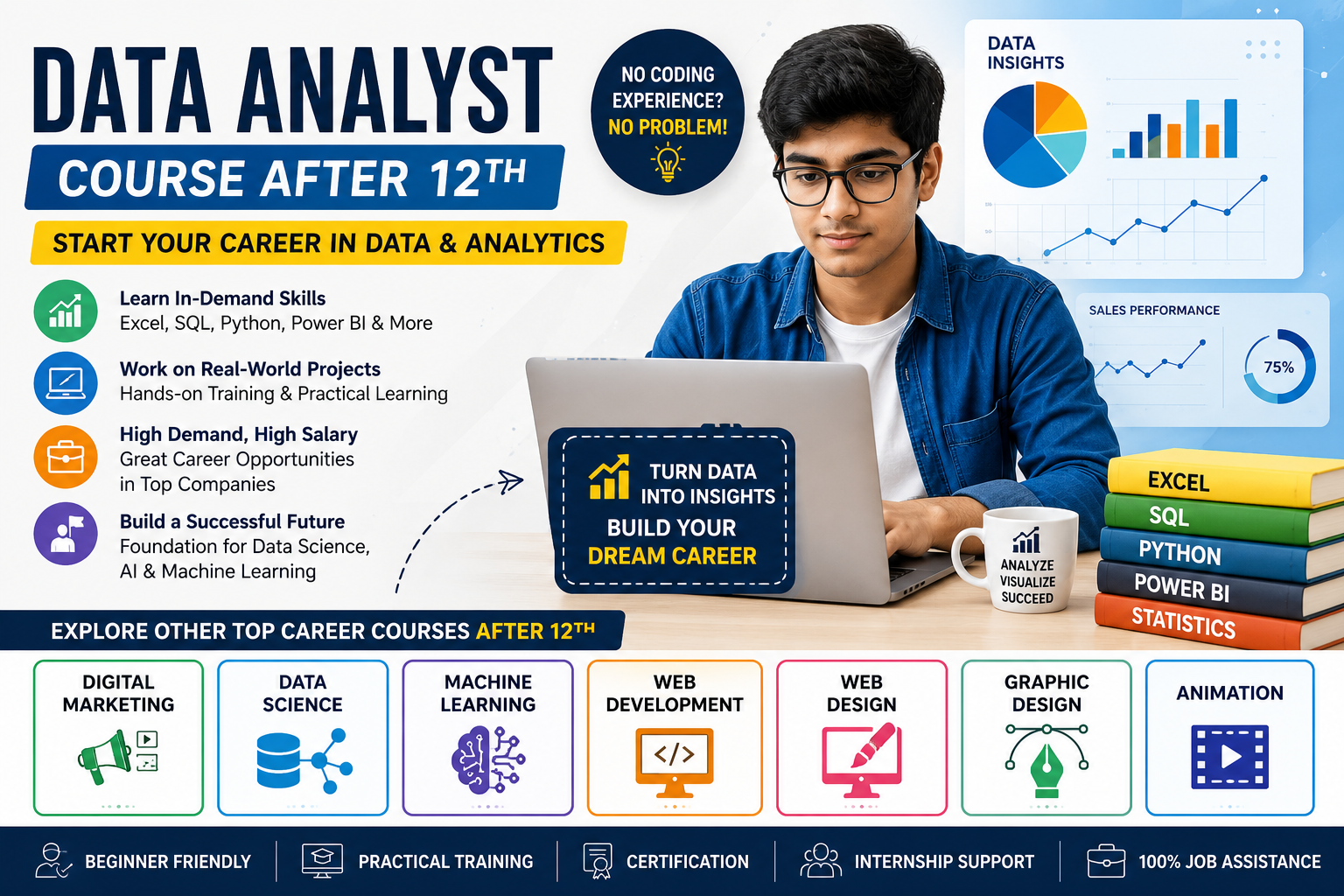
Introduction- Data Analyst Course After 12th
Choosing the right career after 12th can shape your future. Today, one of the fastest-growing and high-demand career options is becoming a Data Analyst. Many students are now searching for a Data Analyst course after 12th because companies across industries depend on data to make business decisions.
A Data Analyst course helps students learn how to collect, organize, analyze, and present data using modern tools and technologies. The best part is that students from Science, Commerce, or even Arts backgrounds can start learning data analytics after 12th with the right training.
Apart from data analytics, students can also explore related skill-based courses such as Data Science, Machine Learning, Digital Marketing, Web Design, Graphic Design, Animation, and Web Development to build strong career opportunities.
What is a Data Analyst?
A Data Analyst studies data to find useful insights for businesses and organizations. They use tools such as Excel, SQL, Python, Power BI, and Tableau to analyze trends, create reports, and help companies make better decisions.
Data Analysts are needed in:
- IT companies
- E-commerce businesses
- Healthcare
- Banking and finance
- Marketing agencies
- Startups
- Educational platforms
Due to rising demand, many students now prefer a Data Analyst course after 12th rather than traditional degree-only options.
Why Choose a Data Analyst Course After 12th?
A Data Analytics course after 12th can help students:
- Learn practical industry skills
- Enter high-demand IT careers
- Build analytical and problem-solving abilities
- Work with real-world projects
- Get internship and job opportunities
- Prepare for advanced careers in AI and Data Science
This field also offers good salary growth and freelancing opportunities.
Skills You Learn in a Data Analyst Course
A professional Data Analyst course usually includes:
1. Excel for Data Analysis
Microsoft Excel is one of the most widely used tools for data analysis because it helps users organize, clean, visualize, and interpret large amounts of data efficiently. With features like formulas, pivot tables, charts, conditional formatting, and data filtering, Excel allows businesses, students, and professionals to analyze trends and make informed decisions. It is commonly used for creating reports, managing databases, performing calculations, and generating insights from raw data. Advanced tools such as Power Query, data validation, and statistical functions further enhance its capabilities, making Excel an essential skill for careers in finance, marketing, business analytics, and data science. Students learn:
- Data organization
- Charts and dashboards
- Formulas and functions
- Pivot tables
2. SQL and Database Management
SQL and database management are essential skills for handling, storing, and analyzing large volumes of data in modern organizations. SQL (Structured Query Language) is used to create, manage, and retrieve data from databases efficiently. It allows users to perform tasks such as inserting records, updating information, filtering results, and generating reports. Database management involves organizing data securely and ensuring smooth access, backup, and maintenance of databases. These skills are widely used in industries like IT, finance, healthcare, e-commerce, and digital marketing, making SQL and database management valuable for careers in data analysis, software development, business intelligence, and data engineering. Students learn:
- Database basics
- SQL queries
- Data filtering and extraction
3. Python for Data Analytics
Python is widely used in analytics. Python is one of the most powerful and popular programming languages used for data analytics because of its simplicity, flexibility, and wide range of libraries. It helps analysts collect, clean, process, and visualize data efficiently using tools like Pandas, NumPy, Matplotlib, and Seaborn. Python is widely used for data analysis, automation, machine learning, and predictive modeling, making it an essential skill for modern businesses and technology industries. With its ability to handle large datasets and generate meaningful insights, Python is highly valuable for careers in data analytics, data science, artificial intelligence, and business intelligence.
Topics include:
- Data handling
- Data cleaning
- Visualization
- Basic programming concepts
4. Power BI and Tableau
These tools help create dashboards and reports. Microsoft Power BI and Tableau are leading business intelligence and data visualization tools used to transform raw data into interactive dashboards and meaningful reports. These tools help organizations analyze trends, monitor performance, and make data-driven decisions through visually appealing charts, graphs, and real-time insights. Power BI is widely preferred for its seamless integration with Microsoft products, while Tableau is known for its advanced visualization capabilities and user-friendly interface. Both tools are extensively used in industries such as finance, healthcare, marketing, retail, and IT, making them valuable skills for careers in data analytics, business intelligence, and data visualization.
5. Statistics and Data Visualization
Statistics and data visualization play a crucial role in understanding and interpreting data effectively. Statistics helps in collecting, analyzing, and drawing meaningful conclusions from data using techniques such as probability, regression, hypothesis testing, and data distribution analysis. Data visualization, on the other hand, transforms complex datasets into easy-to-understand charts, graphs, dashboards, and visual reports that improve decision-making and communication. Together, these skills enable businesses and organizations to identify trends, measure performance, and make accurate predictions. They are widely used in industries like finance, healthcare, marketing, research, and technology, making them essential for careers in data analytics, business intelligence, and data science. Students learn how to:
- Understand trends
- Present business reports
- Analyze patterns and predictions
Eligibility for the Data Analyst Course After 12th
Students from almost any stream can join:
- Science students
- Commerce students
- Arts students
However, students with basic computer knowledge and logical thinking may learn faster.
After completing a Data Analyst course, students can apply for roles like:
-
Data Analyst
-
Junior Business Analyst
- MIS Executive
- Reporting Analyst
- Data Visualization Executive
- Analytics Associate
With experience, students can later move into advanced fields like Data Science and Machine Learning.
Related Courses After 12th
Along with Data Analytics, students can also explore other job-oriented courses.
1. Data Science Course After 12th
Data Science is one of the most popular technology careers today. It combines programming, statistics, and data analysis. Data Science helps you turn this knowledge into valuable skills like data analysis, Python, SQL, Power BI, and machine learning. Companies use data to make smart business decisions, so there is a high demand for skilled professionals in this field. A data science course after BCom can lead to careers such as Data Analyst, Business Analyst, or Junior Data Scientist with strong salary growth and future opportunities.
Skills covered:
- Python programming
- Data analysis
- AI basics
- Machine learning concepts
Career opportunities:
- Data Scientist
- AI Analyst
- Business Intelligence Analyst
A Data Science course after 12th is ideal for students interested in data, logic, and technology.
2. Machine Learning Course After 12th
Machine Learning is part of Artificial Intelligence, where systems learn from data. Machine Learning is used by companies to automate tasks, predict trends, improve customer experiences, and make smarter business decisions using data. By learning skills such as Python, algorithms, data handling, predictive modeling, and AI tools, BCom graduates can enter one of the fastest-growing industries. A Machine Learning course after BCom can lead to career opportunities such as ML Analyst, AI Executive, Data Science Intern, or Automation Specialist. It is a high-demand field with strong salary potential, long-term career growth, and opportunities in finance, e-commerce, healthcare, and technology sectors.
Topics covered:
- AI algorithms
- Python programming
- Predictive models
- Data training systems
Career options:
- Machine Learning Engineer
- AI Developer
- Data Engineer
A Machine Learning course after 12th is best for students who enjoy coding and problem-solving.
3. Digital Marketing Course After 12th
Digital marketing helps you combine this knowledge with practical online skills like SEO, social media marketing, Google Ads, content marketing, and analytics. It offers high job demand, quick career growth, freelancing opportunities, and chances to work with startups or global brands. Since businesses are moving online, a digital marketing course after BCom can open doors to exciting and well-paying career opportunities.
Topics covered:
- SEO
- Google Ads
- Social media marketing
- Content marketing
- Analytics
Career options:
- SEO Executive
- Social Media Manager
- Digital Marketing Specialist
A Digital Marketing course after 12th is suitable for students who enjoy creativity, branding, and online business.
4. Web Design Course After 12th
Web Design focuses on creating attractive and responsive websites. Web Designing teaches practical skills such as HTML, CSS, responsive design, WordPress, Figma, and website layout creation. Every business today needs a professional website, which createsa strong demand for skilled web designers. A Web Designing course after BCom can lead to career opportunities such as Web Designer, WordPress Designer, UI Designer, or Freelance Website Creator. It is a creative field with good earning potential, freelancing opportunities, and long-term career growth.
Skills covered:
- HTML and CSS
- Responsive design
- UI basics
- Website layouts
Career options:
- Web Designer
- UI Designer
- Frontend Designer
A Web Design course after 12th is ideal for creative students interested in websites and design.
5. Web Development Course After 12th
Web Development is one of the best technical careers after 12th. A Web Development course teaches valuable skills such as HTML, CSS, JavaScript, React, Node.js, PHP, databases, and website application development. Since every business needs websites, e-commerce platforms, and web applications, skilled developers are always in demand. After completing a Web Development course after BCom, students can work as Front-End Developer, Full Stack Developer, Web Application Developer, or Freelance Developer. It is an excellent field for long-term growth, remote work opportunities, and global career options.
Topics covered:
- HTML, CSS, JavaScript
- React and Node.js
- Backend development
- Database integration
Career options:
- Full Stack Developer
- Frontend Developer
- Backend Developer
A Web Development course after 12th offers strong job opportunities in IT companies and startups.
6. Graphic Design Course After 12th
Graphic Design is a creative career option focused on visual communication. A Graphic Design course teaches practical skills such as Photoshop, Illustrator, Canva, CorelDRAW, typography, logo creation, and social media design. Every company needs visual content for advertising, branding, websites, and promotions, which creates a strong demand for skilled graphic designers. After completing a Graphic Design course after BCom, students can work as a Graphic Designer, Brand Designer, Social Media Designer, Packaging Designer, or Freelancer. It is a rewarding field with flexible work options, creative freedom, and strong career growth.
Tools covered:
- Photoshop
- Illustrator
- Canva
- InDesign
Career options:
- Graphic Designer
- Brand Designer
- Social Media Designer
A Graphic Design course after 12th is suitable for students interested in creativity and branding.
7. Animation Course After 12th
Animation is a growing field in entertainment and digital media. An Animation course teaches skills such as 2D animation, 3D modeling, character design, motion graphics, video editing, and visual effects. With the growing demand for animated content in films, gaming, advertising, OTT platforms, and social media, skilled animators are highly valued. After completing an Animation course after BCom, students can work as a 2D Animator, 3D Animator, Motion Graphic Artist, Video Editor, or Character Designer. It is an exciting career with creative satisfaction, freelancing opportunities, and strong future growth.
Skills covered:
- 2D and 3D animation
- Motion graphics
- Storyboarding
- Character animation
Career opportunities:
- Animator
- Motion Graphics Artist
- Video Editor
A career in animation after 12th is ideal for students interested in gaming, films, and creative media.
Which Course is Best After 12th?
The best course depends on your interests and career goals.
| Interest Area | Best Course |
|---|---|
| Data & Analytics | Data Analyst, Data Science |
| Coding & Technology | Web Development, Machine Learning |
| Creativity & Design | Graphic Design, Animation |
| Marketing & Branding | Digital Marketing |
| Website Design | Web Design, UI UX |
Benefits of Choosing a Skill-Based Course After 12th
Skill-based courses help students:
- Learn industry tools
- Gain practical experience
- Build portfolios
- Start freelancing
- Apply for internships and jobs faster
These courses are often more career-focused compared to traditional academic programs.
How to Choose the Right Course After 12th?
Before selecting a course, ask yourself:
- Do you enjoy technical or creative work?
- Are you interested in coding or design?
- Do you want a fast, job-oriented course?
- Do you prefer business, media, or IT careers?
- Does the course include practical projects and placement support?
Choosing the right course after 12th can help you build a successful future career.
Conclusion
A Data Analyst course after 12th is an excellent choice for students who want to build a career in technology, business analytics, and data-driven industries. With increasing demand for data professionals, this field offers strong career growth and salary opportunities.
Students can also explore related fields like Data Science, Machine Learning, Digital Marketing, Web Development, Web Design, Graphic Design, and Animation, depending on their interests and career goals.
The key to success is choosing a course that matches your passion and helps you develop practical industry skills.